Tuesday, 29 January 2013

Black & White in the Pink

Pier 3 where ferries arrive and depart for Discovery Bay from Central


With the recent death of Andrée Putnam (19 Janaury 2013), the French interior designer, I revisited some of her famous designs. Underlying her work is a real appreciation for geometry and space. The famous black and white checkerboard tiles and geometric carpets became her signature style. She had a real sense for using space, furniture with strong geometric lines and staircases with dramatic symmetries or spirals.

Landscape architecture and planning also require a sense of space and materials. For some time I have been obsessed with patterns, tiles and paving materials, trying to understand the sensibility that informs the urban environment of Hong Kong. When asked, very few people have commented upon the pervasive use of pink in the city…and no one whose hometown this is. Colour is culture specific. When I put the question to local Hong Kongers about the prolific use of pink in the city, they did not respond….and expressed almost an incredulity about the word ‘pink’…..which is of course a red hue mixed with white, yet the word exists in both Putonghua (Mandarin) and Cantonese - tao hong se. As far as I can gather, there is no specific symbolic association to pink in China apart from being regarded as a feminine colour.


From the harbour front, through Central up to Mid-levels, pink can be found in materials used for paving, staircases, flooring, and buildings. These materials include bricks, tiles, composite and natural stone. Architects and workers in the Highways department specify these materials. In one specification document, a pink paver was described as ‘a beautiful peaceful colour’.


Decorative paving and outdoor seating near Pier 3

From the water’s edge, along the elevated walkways and the Mid-level escalator, the main geometry is the square, interspersed with rectangles. From the culture of the moon gate, circles are sparse as you go along this urban route from the sea to the mountain. 


The rotunda below IFC Tower 1
In the IFC 1 Tower the base and structure rests upon huge circular pillars which is expressed to the casual visitor as a large rotunda linking different walkways and levels.

 
Mid-level escalator across Queen's Road Central
A more modest rotunda is to be found on the escalator across Queens Road Central where the old Central Market, the building called 100 Queens Road Central and the escalator meet. This rotunda is only expressed in the roof covering the escalator and is not echoed at floor level.

 
This small display is one of several panda installations
In the IFC Mall, on a wash of shiny pale pink flooring, I found some black and white – gigantic, soft cuddly pandas frolicking about for the Chinese New Year - a reminder of the concerted efforts being made to integrate mainland China and Hong Kong.

Friday, 9 November 2012

Chasing cheongsam at Shatin Racecourse on Sa Sa Ladies Purse Day

-->
This is the enclosure where the horses are paraded before races.


Every now and then, anthropologists, in search of stories about people and things, can be led up the garden path, or as in this case, be led on a wild goose chase to the racetrack.

The cheongsam is a one-piece Chinese ladies dress that originated in 1919 when a group of female students in Peking adopted a version of the male changsan, a long robe, derived from the Manchu magau, discarding the blouse-and-skirt ensemble that had been in fashion since the 1911 Revolution. The cheongsam, or qipao (Mandarin), was the dress for progressive women and leading female intellectuals. During the 1950s and the 1960s, the qipao lost its elitist image and became a more general trendy form of daywear.

This early 20th-century symbol of modernity has once again become elitist mostly due to its prohibitive cost and contemporary Chinese women’s preference for Western brands, which they now see as being ‘modern’ and progressive. A proper fitting cheongsam requires three to four fittings and takes about a month to make from a specialist tailor. They are mostly ordered for important family events such as weddings and days with special significance, such as the 1997 handover day when Britain returned Hong Kong to China. Many women wanted ‘something Chinese’ to wear on that day.

I have been in conversation with Mrs F, a local Hong Kong cheongsam tailor about life in Hong Kong, the intricacies of making the deceptively delicate-looking cheongsam by hand, procuring fabrics and why her clients commission these beautiful feminine dresses today. The cheongsam is a versatile garment that can be fashioned to suit any occasion. But it is the white wedding dress that you see so often in the parks, piazzas and natural beauty spots on soon-to-be brides.

Along the Mid-level escalator there are many wedding dress shops and wedding photographers that offer extensive packages for shoots in exotic destinations. A visit to one of these shops led me to Leon, an accessory maker with a tiny shop near Nam Cheong Street that resembles a cabinet of curiosities and is much loved by design students. One thing led to the other and Leon invited me to the Sa Sa Ladies Purse Day at the Shatin Racecourse to watch a show by a contemporary fashion designer who wants to revive traditional Chinese dresses. I was even offered one of these beautiful dresses to wear on Ladies Purse Day at the races.

The journey to Shatin took on a bizarre quality as most of the commuters were hardened punters who were studying the racing schedules either in newspapers or small booklets. None of them seemed remotely interested in the Sa Sa affaire, just anxiously plotting their day’s bettings. The MTR link to the Shatin racecourse from central Kong Kong is pretty efficient, and an elevated walkway leads straight from the station to the racecourse. Entry to the premises cost around HK$10, less than a pound, from where you enter a huge hanger, lined with horse sculptures on the one side, and sales tables for Sa Sa Ladies Purse Day merchandise on the other. After a long walk to the member’s enclosure where I was to meet Leon, I had to bluff my way in and up to the Bauhunia restaurant as no Leon could be found nor did he respond to calls. There was a table booked under his name though, so things looked up. After two hours, no one else had arrived at the table, and I ordered what must be the best roast chicken in Shatin. After another half an hour, the rest of the troops arrived and they fell on the food and tea. These hungry students were to model the costumes based on traditional cheongsam styles.
Any opportunity, a photo opportunity

Still no Leon. Still no phone contact. Fashion shows came and went between the races, but no traditional costumes to be seen except if you count in the delicious pink puffballs worn by models in the ladies toilet. Odd groups of girls approached the table to pick up headgear, mostly feathery fascinators that I presume came from Leon’s shop.

Still no Leon, still no telephone contact. So I left and took some pictures of girls on stiletto heels taking pictures of each other in front of the horse sculptures and the Sa Sa Ladies Purse Day merchandise in the now deserted hanger. Guess what, a week later Leon called to apologize for his poor arrangement. But I think he was really calling to find out if I knew who had the cheongsam costumes as there was a furious designer demanding compensation for lost goods.

Sa Sa Ladies Day merchandise - Barbie land?
Not a lot gained about cheongsam, but I now know the story of the origins of Ladies Purse Day which is pretty charming and that Sa Sa is one of the largest purveyors of cosmetics in Asia.

In a tradition established a century ago, the jockey, owner and trainer of the winning horse would be awarded gold sovereigns by a renowned lady. When Hong Kong racing turned professional in 1971, the custom of presenting gold sovereigns was dropped. It was reintroduced in 1990, using a Hong Kong Lunar New Year gold coin instead of a sovereign. Nowadays, a gold coin contained in a wallet will be presented to the winning jockey, owner and trainer. (HKJC website)

Monday, 11 June 2012

Bulging Bags


Many moons ago, in the old South Africa, the specification of plastic bags used by the clothing retailer I was designing packaging for, was for strong and biodegradable bags. This was the first time I heard the term ‘third-world briefcases’ so glibly referred to by the then marketing manager. He was proud of the fact that poor children used ‘his’ strong bags as school satchels. The biodegradable quality of the bags was a token solution towards the millions of bags that littered the countryside.

A ‘new South African’ solution to reduce plastic bag littering was to start charging for them, an incentive that is also employed in Hong Kong to reduce its mountains of waste. Lunchtimes, plastic bags abound in Hong Kong, tightly holding a variety of polystyrene and plastic containers filled with steaming hot noodle soups, barbequed meats and rice and paper cups of tea.

Shopper and tourists underneath the  Mid-level escalator
The range of handbags on the Mid-level escalator in Hong Kong is noticeable. Practical, nondescript, small, flashy, large…the full gamut can be seen here. My interest in handbags was piqued by being repeatedly shoved about on the underground by the ever-larger ladies’ bags, almost as dangerous as backpackers unexpectedly swingeing around with their hard rucksacks into soft flesh, not taking account of the lack of space. The forlorn look of a discarded bag on a ledge below the Mid-level escalator also sparked my interest – what exchange or incident resulted in a bag and its spilt contents landing up amongst a piece of hosepipe and some metal bars? I returned to this site a week later and the bag had been removed. However, the rest of the debris had been left. So, what make a section of hosepipe and metal rods acceptable waste and a handbag not?

Is it because handbags are ‘intensely personal objects’ and ‘intensely social ones’ as described by Janet Hoskins in her article on the Kodi betel bag in Sumba, Indonesia (1998: 24) and that handbags can stand for a ‘kind of alter ego, a metaphor for the own self’ (1998:26)? There is no doubt that the sight of the discarded handbag was disturbing, suggesting physical abuse, robbery or some encounter that went out of control. All the ‘secrets’ or ‘hidden knowledge’ held within this bag was almost revealed, and touched upon the taboo or sanctity that guards the contents of women’s bags.

Bags are also social indicators, and express the ‘wealth and social prestige of the owner’ (Geirnaert 1992: 56). This was no more explicit than at a recent wine tasting. A petite, well-presented Hong Kong lady wore a bag almost half her size, obscuring her body most of the time. The colour of her bag matched her tight-fitting pencil skirt perfectly. It crossed my mind that between her bag and her towering high-heeled shoes, she had some pretty lethal weapons at hand. This is one lady whose bag will not easily land up on a ledge below the Mid-level travelator.

Wednesday, 28 March 2012

Rethinking Hong Kong


St Joseph's Cathedral completed in 1886.
A visit to Hanoi, termed the ‘city in the bend of the river’ by Emperor Tu Duc in 1831, has somehow brought Hong Kong, also flanking a neat curve of water in the South China Sea, into perspective.

Hong Kong and Hanoi have been settled since the Neolithic era. But Hong Kong, in a remote part of China and far from the centre of Imperial power has  seen intermittent settlement till the arrival of the small farmers and fishermen that were here before1841 when the British took over the terrain. The makers of the Neolithic rock engravings on large granite boulders that dot the coastline have long since become a mere speculation in the history of Hong Kong.

Today, Hanoi is a large, continuous urban sprawl with most of the architecture still modeled on the French colonial style. The street density is high, but there are few tall buildings. Similar to Macau’s colonial architecture that was a Portuguese translation of European styles tempered by local temperament and skills, the buildings in Hanoi have undergone similar translations to become a local vernacular. They strongly evoke French architecture but have a decorative quirkiness that obviously derives from a local sensibility. Most of the buildings have inviting, deep verandas with ceiling fans to shade from the summer sun and heat.

Hanoi has not adopted modernism or modern lofty architecture in the same way that Hong Kong has. Land is a scarce commodity in Hong Kong, not only because of its limited size, but also as it is the source of its wealth. The low-rise character of Hanoi is not however what was most intriguing, but the organized chaos of the traffic in the city and its street life on pavements.

After-school traffic in the street opposite the cathedral.
Thousands of Honda motorcycles and scooters travel in every direction of the compass. They fill the streets, pavements, markets and alleyways. When there is no oncoming traffic, they swarm across into the free lane, only to contract back into semblances of two-way traffic flow when there is opposite flow. Everyone wears helmets and a family of four on a bike is not an unusual sight. The saving grace though is that they all travel very slowly. By contrast, the flow of traffic in Hong Kong is very ordered, disciplined and law-abiding. But sometimes it gets precarious as taxi drivers neither exceed, nor travel at speeds less than the speed limit around the reinforced concrete faces along the hair-raisingly, narrow roads that curve around the Peak.

The people of Hong Kong regularly take control of the streets for orderly protests and on Sundays house helpers from Indonesia and the Philippines spill into every possible safe public space on walkways, parks and piazzas. Here they sit on cardboard sheets and decamp for the day chattering, eating, playing games, giving one anther pedicures and often using their phones to talk to other friends and family at home. This decampment is tolerated, but every now and then an angry letter to the newspapers makes its voice heard.

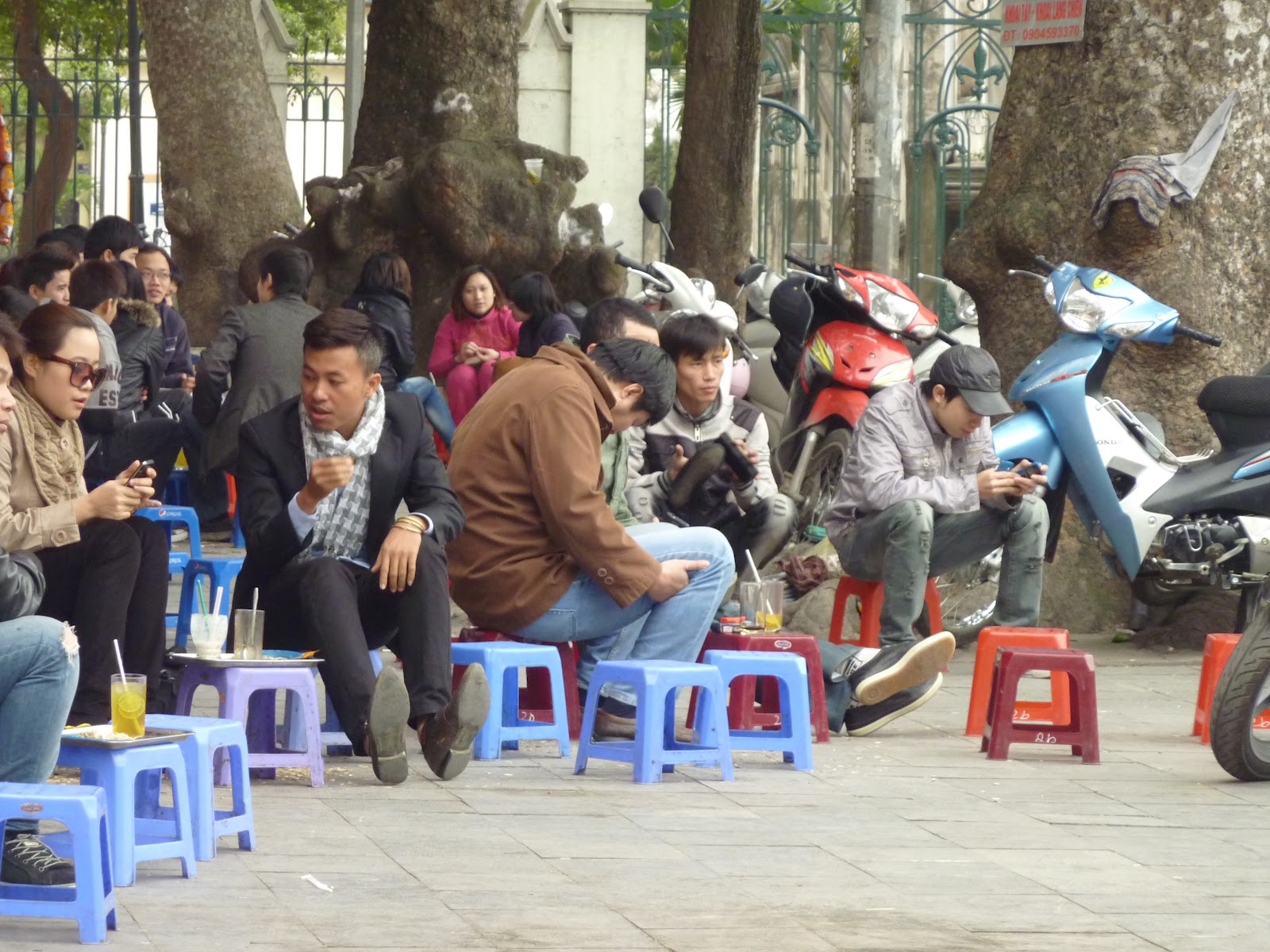
Street cafe on the cathedral square.
This is in stark contrast to Hanoi where the streets belong to the people who travel, sit, eat and drink on any sidewalk. The pavements are not well tended and narrow and widen as the old footprint of the city, trees and parked motorcycles allow. Brick pavers are often missing and there is grey dirt across all the road and pavement surfaces. This seems not to be a concern, as many little pop-up restaurants and bars just appear on random-looking places (locals must have a greater sense of place concerning these than we as visitors had). The little stools used in street cafes in Hong Kong are small, but in Hanoi they seem like miniature versions.

Hong Kong has built an amazing skyline and adopted verticality as a massing principle. This has left me curious about the way of building in Hanoi and what it says about the Vietnamese that overcame the military power of both France and America.


Tuesday, 24 January 2012

Collecting views and memories


Walker Bay photographed from De Kelder where our walk ended.


Walking in the sand. The prospect of walking along an unspoilt stretch of beach along the Overbergstrand that has been quietly inviting me for decades was a little daunting after three weeks of endless eating and drinking, eroding the little fitness I had built up over the last couple of months. But good to be freed from the semi-circular patterns of the wooden end-grain chopping board that I seemed to be perennially chained to during Christmas time.

We walked towards De Kelder, as there was a wind from behind which would have been unpleasant face-on. This meant that the glorious mountain views were behind us. However, the young couple that accompanied us more than compensated for the loss of the views: a darting young vamp that twirled around her boy. The lass must have covered twice the distance than anyone else as she teased the bloke by dancing and turning around him in her tight blue jean shorts and cropped, off-the shoulder, black top. If the walk was mesmerising, so was this display of chemistry that kept a taught, invisible string spun between them. To be young and brimming with life is wonderful to observe and provided a timeless and filmic quality to the outing.

The lagoon mouth was shallow and we waded across…or those of us who were barefoot or wearing open sandals. Some ladies, who did not want their walking shoes wet, had to be lifted across the water. Luckily the channel connecting the lagoon and sea was a mere trickle during low tide and slightly undermined the men’s gallantry.

The sandy stretch between Grotto Beach and De Kelder curves for more than 17km along the coast. The sun was out and a little westerly wind whipped us along. The strip of beach narrows and widens in places, alternating hard surfaces that are easy to walk on and soft, deep sand that bites in the calves. WG Siebald’s question came to mind: ‘Where did these [young] people actually learn to walk?’ (2004) as I observed the walking pace of the group, all kitted out in their state-of-the-art sports shoes. We made two pit stops to refuel, and these were leisurely and sociable, like baboon troops that have found a safe feeding spot. However, we never interrupted our walk once to look at the views or the grassland fynbos along the way, so one of the enduring memories of this walk are of Nike-shod feet and a debate about what shoes are best for a walk along the beach.

Street stalls and a typical Hong Kong delivery van in Soho.
Walking on ground level in central Hong Kong, one is devoid of a sense of horizontal space and only a narrow strip of sky is overhead. In places the deep urban canyons never allow direct sunlight. The surfaces underfoot change from asphalt to stone curbs and an assortment of tiles. A friend commented recently that you can distinguish between visitors and home-grown users of the Mid-level escalator in Central: visitors loiter around and locals use it in an efficient manner to get to their destination as quickly as possible. Most visitors use the walk up the escalator for taking pictures of the daily life of Hong Kongers, and there are certain scenic spots that appeal to most people. The oldest wet market in Hong Kong around Gage and Graham Street, the overhead advertisements down Wellington Street… 

Vagrant's trolley used for scavenging.
During lunchtime, office workers pour out of buildings and make a dash to their chosen eatery or take-away restaurant. It is congested at this time of day and long queues form in front of favoured places. A regular sight every day is of people walking back to offices with small polystyrene containers in white plastic bags swinging carefully as not to spill. By two in the afternoon, the city becomes once again a more restful place and you only have to dodge the endless deliveries from trucks that are wheeled on flat, four-wheeled trolleys that are niftily stacked with surprisingly large loads. A timely tip of the toe edges the trolleys up or down street curbs. And again Siebold’s question comes to mind as I observe too the short range of the city dweller’s walking gaze. It seems as if the distant view is captured only by the camera lens.

Monday, 28 November 2011

Telling directions in the city


It is some time since I read Italo Calvino’s Invisible Cities, but another author citing the description of ‘Zaira, city of high bastions’, resonated with my recent experiences in Hong Kong. 

I could tell you how many steps make up the streets rising like stairways, and the degree of the arcades’ curves, and what kind of zinc scales cover the roofs; but I already know this would be the same as telling you nothing.
  
In the time it took to travel in a red Hong Kong cab, recently described by a young visitor as cooler than New York cabs, from our apartment block to the Prince’s Building in Central, Calvino’s description of Zaira, unfolded in real time.
Taxis in front of the old Central Police Station in Central.
An unknown neighbour approached me jovially. When I looked perplexed, this larger than life lady told me she had been in Canada to escape the Hong Kong heat. She flapped a handkerchief and crossly explained that her son misled her that winter had already arrived in Hong Kong and here she was, dripping with perspiration. The lady in black – frilly organza blouse over snappy black trousers, patent leather pumps, Jackie O sunglasses, swirly diamond earrings and helper in tow – upon hearing that I was learning Mandarin, told me, in a rather off-hand manner, that she knew all the Chinese languages. These languages were acquired during the ‘terrible times’ when Japan invaded Hong Kong and they had to flee from place to place in mainland China. She inquired equally casually on what floor I lived. The 8 floors difference immediately established a pecking order between us.

Streets usually serve as tracks for long-distance runners. Architects often aspire to bring the street into the mall. Something of a cross-over occurred when the Citibank Tower’s fire escape served as the track for a charity fitness challenge….vertical running 55 floors above ground? Super-fit contestants looked deathly pale when they completed the run.
 
Citibank Plaza was designed by Leo A Daly
Marco Polo’s acknowledgement to Kublai Kahn that the description of heights, angles and materials of Zaira amounted to telling you nothing. So what then to make of a Hong Kong taxi driver that drew an air pistol on another cabbie that pushed in front of his car, or why the lovely lady in black uses the height of an apartment to establish social order, or a staircase used as a running track? These spatial configurations, do they not tell you something about place and space in the city? Below, behind, in front, above...to the left or right, all determine value. But they also tell you nothing till you know the social and material relations that govern Hong Kong: that the income generated by land sales is government’s most important source of income; that it is a divided place where rich and poor are far removed; where memories of the past determine the present and future, and every step, arcade curve and pink tile or stone are measured and recalculated for profit, practicality and efficiency. After seven months in the city, I know a lot more about Hong Kong, but at the same time, I often feel that I can tell you nothing…. 

Sunday, 9 October 2011

African Bizarre: up close and intimate in Soho

A new friend's 40th saw us at the Makumba Lounge and Bar for an Africa Bizarre celebration. A very chic, but sour, lead singer sat in the corner when we arrived and the mood never lifted throughout the entire evening. She was, thankfully, in good voice and sang Happy Birthday without smiling once. Quite an achievement.

Hong Kong must have been stripped bare of every fake zebra and tiger skin outfit this weekend, and there were some extraordinary suits, dresses with daring cut outs, stockings and peacock feathers. Also a banana on tiger print legs. But first prize went to two guys in full print suits - the one in zebra and the other in tiger wearing trendy dark, squared-framed Jay Jopling-type glasses. The tasty African tapas, a hybrid misnomer if ever there was one, included mince balls, chicken wings, African spring rolls (what's that?), deep fried sweet potatoes and plantains.

When we started reflecting upon celebrating with the 40 year old young things, we thought it time to move on from Peel Street and walk around Soho. In Hong Kong, Soho stands for South of Hollywood Road, and usually means either Staunton and Elgin Road. As it turned out, we didn't get much further than the Feather Boa in Staunton Road, an unmarked, so-called private club. A chippy young lass from England remarked that she was not sure how private a club is that is listed in The Lonely Planet.....still, the first time I had to show my ID to order a drink in a long time. Same chirpy lass produced a friend's local ID card to get her drinks and no one noticed the difference. The lady mixologists were very professional, and churned out chocolate martinis with floating Maltesers and strawberry daiquiris served in glasses with frosted chocolate rims with relentless energy. They went through three containers of chocolate powder for the frosting in the time I drank one cocktail. The space, a former antique shop, was heaving with people and you literally felt the bones of bodies pressing against your back. We had a conversation with a happy Swedish visitor who kept on handing out red roses from the vase on the counter to his blonde compatriots. When asked if he liked visiting Hong Kong, he took a deep breath and said that during an earlier massage session, the masseuse kept on trying for what is termed 'a happy ending'...so I wondered what's the case with the roses then?

The morning after? A little dim and dry around the head...and a wistful thought upon my co-drinker's comment that perhaps the years between 40 and 50 are the best...so party girl, the best is yet to come! 

Tuesday, 20 September 2011

In search of happy gods in Repulse Bay

I was feeling disgruntled with my new life in Hong Kong and blaming it on the lack of open skies and feeling closed in by the spectacular view across Victoria Harbour through some gaps between 'big things', also called skyscrapers, that dwarf one's every step, being and breath. The special thing about this city is the continually changing perspectives as you walk the streets of buildings, vistas and slopes, a moving diorama. However, despite this visual pleasure and the welcome relief of shadows cast by tall buildings in the heat, it is as if they 'hang in space' and have a presence of just 'being there', displacing space.

The southern part of Hong Kong Island, facing the south china seas, has a different sensibility. It is more relaxed, a shangri-la or permanently happy land isolated from the outside world as James Hilton wrote of in The lost horizon (1933). At the end of the Repulse Bay seaside walkway, I found a happy god on whose plinth is written in gilded letters, the following inscription:

The old man from the moon is
a happy god in charge of
love and matrimony.
He ties the couple's legs with red
string, and their hearts with a crimson belt, and puts their names in the celestial register so that they will live happily ever after after.

This god is surrounded by many other mosaic gods and deities at the Tin Hau temple. Gaun Yin, the goddess of sympathy, compassion and mercy and Tin Hau, the goddess of the sea, or literally the queen of heaven, tower over the temple precinct. The story of Tin Hau goes that as a 13-year old, she met a Toaist priest who taught her how to predict the future, and help the sick and the weak. She supposedly traveled the seas on a reed mattress and saved people from drowning and thereby gathered the attribute as the goddess for safety on the seas. And it is here that I found peace and reason to be in Hong Kong - to collect stories from old men, happy gods, red strings and crimson belts.

The TIn Hau temple is also, appropriately, home to the Hong Kong Life Guard Club Training Headquarters. Behind Guan Yin and the temple, oddly filled with cold drink fridges, stands The Lily, the residential development designed by Norman Forster and Partners where a 3-bedroomed apartment costs HK$165,000 per month to rent. One is never far away from the West/East dichotomy in Hong Kong.

Monday, 22 August 2011

Why do we want things?

I have been on a mission to track down tempered steel picture nails in Wanchai, the area that has many little hardware stores, framers, stationers and art supplies stores. Up and down Queens Road East, Johnston Road and all the streets that link them....nowhere to be found. They all just shrug and offer masonry screws and plugs or picture hooks with multiple small pins that you hit into the wall. I need steel picture nails because I do not have another thing, an electrical drill, to fix the masonry screws into the wall. This means I have to either contact Amanwithadrill.com or buy this thing. The bare walls have become intolerable, as without things on them, it just does not feel like home. And that big thing, that throbbing picture of the city outside, the tall, gigantic buildings in Central, needs to be tempered by some other things.

Thinking about things and why things are important (anthropologists have filled libraries on this topic) made me think about what a girl during the recent riots in London said: 'we have showed the rich people that we can take their things and they can do nothing about it'. Gavin Esler, the anchor on BBC's Dateline in a recent TV debate, summarized a panel discussion on the rioting as 'the looters wanting things that they see the rich have'. These are perhaps banal statements about what the rioting was all about, but the fact of the matter is that the looters gave expression to their resentment, disenfranchisement and frustrations by damaging and looting things, thereby upsetting the status quo.

The Hong Kong Museum of History is on the left.


Delivery man from the stationary shop.
I will be relieving my frustration with and fear of the white wall spaces by putting up things like maps, new and antiquarian images of Hong Kong - all showing various things - using screws and wall plugs, and hopefully not be damaging the landlord's property, whilst I ponder the serious topic of the relationships between violence and things.

The photographs include a picture of the Hong Kong Museum precinct that houses a collection of things that explain the peopling of and various customs practiced in Hong Kong, and the shop to the right sells various paper ware, including envelopes for money gifts, and a variety of ritual joss papers and paper objects that are burned during ancestral worship. Incidentally, there was an outcry last week in the papers because the Palace Museum curators in Beijing were neglectful with the peoples' things and broke some ceramic plates in their care.

Sunday, 10 July 2011

Little things that make the world go round

A sunny, early evening in London after the first day of the Courtauld's Intersections: Architecture and Poetry conference brought welcome, fresh air after stuffy lecture theatre sessions. They operate the air conditioning till the speakers start and then have to put it off as it is too noisy! Can some philanthropist help this worthy institution out of their misery? We were all wilting from a lack of fresh air and the heat. However, there was an interesting talk by Mike Tonkin and Anna Liu who explained their design solutions drawing from natural geometries that kept some of us awake.

Outside, it was a glorious summer's day and people were running and splashing in the courtyard fountains surrounded by bronze Chinese zodiac animals. Liquids of another kind were flowing on the terrace overlooking the Thames. There was a very noisy tent from where drinks were served, but sensibly, the eastern side of the terrace was left open. A young Chinese girl sat at a table with four chairs - it was very busy and full - and I asked if we could share the table. She was very emphatic about not sharing, as she was waiting for her date! Amused, we managed to scrounge chairs from elsewhere. Nothing like sharing a drink in good company in beautiful surroundings. This little urban encounter made for a pleasant day.


Other little things that I picked up in London that give pleasure in China are blonde hair elastics that cannot be bought there for love or money and a naff-looking, curious silk powder foot spray that eliminates the need for those dreadful, nude, creeping liners in summer shoes. And another thing, back in Hong Kong, I am so grateful to block out the never-ending, reflecting, flashing lights of IM Pei's Bank of China Tower at night, not with an eye guard, but by drawing curtains.


Monday, 23 May 2011

To Mao or [not] to marry


This installation in the window of Lane Crawford's 'home and lifestyle store' of colourful Mao cherubs hovering above a rather grim-looking couple is by Beijing artist Qu Guangci.
These Maos may well ponder their presence in a shop that was started by two Scotsmen, Thomas Ash Lane and Ninian Crawford, in a bamboo structure on the Hong Kong waterfront in 1850. This leading specialty store promises the best of everything from around the world. The weightlessness of the suspended angels is echoed in an earlier series of birdman works by Guangci that was influenced by Italo Calvino's story The baron in the trees and the paintings of Bada Shanren (1624-1705).

Guangci is attracted to Calvino's sense of fantasy, aesthetic freedom and flexibility but in particular his use of 'lightness':    
I always endeavor to lessen the sense of heaviness: the heaviness of human beings, the heaviness of heavenly bodies, and the heaviness of cities.

The light, pop-like irreverence of the Mao cherubs belie the heaviness of the Cultural Revolution from which these figures stem. The heaviness of cities and human beings was reported in the South China Post of 19 May 2011:

A 22-year-old woman in a wedding is grabbed and hauled to safety by a community officer after she jumped from a window in a seven-storey residential building in Changchung, Jilin province. According to reports, the dramatic rescue took place after the woman's boyfriend of four years jilted her as they were making plans to get married. The woman did not suffer any injuries in the incident.

This suspended angel did not have a moment of lightness of being in the city.


http://www.artzinechina.com/display.php?a=834 
http://www.youtube.com/watch?v=5IwBULAQa3k
http://www.artzinechina.com/display_vol_aid375_en.html

Wednesday, 18 May 2011

The groom, the bride, the bridesmaid and Starbucks

Just about every walk through Hong Kong Park you bump into a bridal party of some sorts. Somehow it is always compelling to watch the scenario being played out. It could be the bride on her own, but mostly the groom and bride and a few attendants as you see here. This is not the wedding day, but what they call pre-wedding photography, and already the white high-heels of the girls are scuffed as they traipse through the garden, in search of  unusual locations. In these days, when your glasses fog up as you go outside from the humidity, the bride and bridesmaids have difficulty composing themselves lugging elaborate dresses around underneath the heavy layers of make-up. Perspiration drip from their faces. In fact this whole party was made-up, including the groom. I took some pictures of them and despite the heat they looked wonderful. I was wondering if they made two matching bouquets, one for the pre-wedding photographs and then the wedding day itself. Four bridesmaids sat in our local Starbucks after a grueling session in front of the cameras, now imagine that in London!

Talking about flowers, enormous bouquets are presented at weddings or for businesses celebrations with large A4-sized hand-made writs. Bigger is better seems to be the ethos and they get carted around on delivery trollies. To my London trained eye, used to endless variations of posies or hand-ties, these arrangements seem overwhelming in their composition and choice of blooms. That is till I landed in Happy Valley, that airy neighborhood with a village feel curving around the racecourse that has a sense of space, and saw two florists specializing in the ubiquitous tight bunch of harmonizing or contrasting flowers.           

Tuesday, 3 May 2011

Pillars propping up the city

Cities and societies are propped up by numerous structures and practices. Cheap labour from mainland China and elsewhere has been in endless supply in Hong Kong since the early colonial era and is intrinsic to its economy and ease of living. An agency for 'maids' displayed a window covered with these photographs - all the women were in the same dress and pose. These sheets with personal data, work experience and preferences are personal advertisements for their services. 'Hyacinth is a 36 year old married Roman Catholic woman with 3 teenage children.' In her interview appraisal, she scored 'good' in all categories, including her facial expression (the agency seemed to score no one as being excellent in any category). She seems a godsend for any household, and the 'simple massage' listed as one of her many capabilities would send any Hong Kong matron seeking a house helper in the opposite direction. Do personnel agencies elsewhere display information of this personal nature I wonder? Lisa Law wrote about the Filipina women in Hong Kong (2002), gathering in public spaces around the Central area on Sundays, when they meet in groups to talk, eat and just generally be sociable. The clutter of these gatherings in Chater Park and elsewhere irked the city fathers and big commerce alike in the past, and barricades were put up to control their access to the city's few public spaces. Since I have been here, I have seen Filipina women in all kinds of public spaces during their spare time. They turn public concrete spaces briefly into private spaces with hunched conversations over plastic containers filled with rice, and as far as I can see, chicken pieces, before they return to keep the household wheels running smoothly again for their employers.


During the summer when the typhoons arrive, great amounts of water come gushing down the steep, hilly slopes in the city and could cause landslides. All the slopes are covered in concrete and netting cover the soil surrounding the trees. Narrow maintenance steps are barred to the public and only maintenance workers have  access. Deep gulleys and enormous storm water canals channel rainwater down to the sea. Structures such as these pillars prop up highways that cut through the city and obliterate the flow between areas and public spaces. The Zoological and Botanical Gardens are cut in two by Albany Road. The park is isolated from the rest of the city and nearby Hong Kong Park by flowing, circular roads. Few pavements make it difficult for pedestrian to navigate this area.


Wednesday, 27 April 2011

Hedonic pleasure in the city

Middle Island, Repulse Bay on Hong Kong Island.
The weather is mild and the invite changed from Causeway Bay to the Middle Island between Deep Water and Repulse Bay. This is on the southern side of Hong Kong Island. A beautiful seaside path leads to the stone jetty where a sampan ferry takes members of the RHKYC across to the club house from where members sail small dinghies, row and receive sail training. It also has a modernist clubhouse with a bar and BBQ terrace. Trays of raw prawns, scallops, steak, sausages, chicken and vegetables are put out for barbequing. Two hefty lads with beers in their hands looked sceptically at the two girls who were circling closer to the fire to do the meat and seafood that required some clever timings from the cooks to be ready at the same time. Well, it was quite delicious, and has broken the silent iron rule that it is 'men's territory'....I got the nod from my better half. This of course means that men will have to help with the prepping in the kitchen beforehand. (Why do I take notice of this outdated behaviour that has transcended time and space?)

Red taxi from Deep Water Bay to Central
If the evening on Middle Island was magical, so was the trip back home in the most elaborate taxi....complete with cut glass vase and frilly pink carnations edged in red and a telly pumping out Canto-pop (remarkably close to French pop ballads).

The hedonic pleasure of views are carefully calculated in Hong Kong. Double aspect views of  the mountain and sea are noted and each vertical floor climb commands a rise in rent or purchase price. Where buildings obstruct the sea, it is termed as an 'open view'. So, the views are assessed on three axes....the proximity of surrounding buildings, the vertical height of the window or balcony view, and the horizontal positioning along the building. My preoccupation with space, location and views in the city is a result of our recent flat-hunting in Hong Kong. Now if London real estate was a humbling exercise, this is a shattering one as the market is inflated, the prices high, and stock at a premium. Unrenovated properties translates into property speak as 'original'. We are putting in an offer on an old (1962) colonial property next to the Bowen contour road - great for walking and running. Now let's see if everything goes according to plan.

Monday, 18 April 2011

Bling-bling, ding-ding and trrr, trrr, trrrrrrrrrr..............!

The trams that run up and down from East to West across central Hong Kong date back more than a hundred years. The tram's nickname is Ding Ding, so called after its distinctive bell ring. The tram ride is quite jolly - you hop on at the back, and when get to your destination, you slip 2 HK$s into the cash box or pay by the touch  of an Octopus card under the stern gaze of the driver. This must be the best value item in an at times painfully expensive town. The waist-high doors straighten out to close the open rear platform and gives a sense of old-fashioned security, but bus drivers seem to open doors quite casually in between stops for people to get on and off. EU health and safety regulations? Never heard of them. So it was with precarious pleasure that I hopped on, knowing that I was 'transgressing' faraway rules.

Apart from the incessant traffic noise, the zebra crossings in Central have three sound signals, one for go or the green pedestrian light, and another two for the amber and red signs. This additional sound level is oddly irritating in the already overloaded sensory street environment, but it raises the alertness level.

People who use the tram are everyday workers, unlike the bling-bling wearers inside the shopping malls. On Saturday evening, we attempted to live up to this advertisement of our apartment block on our way to the American Chamber of Commerce's Ball. Desperately out of practice, we consulted You Tube for a waltz demonstration.....that was sadly not needed!  A local TV series of Strictly Come Dancing could change all that?

Thursday, 14 April 2011

Living amongst giants and dragon boats

Living amongst tall buildings is both exhilarating and oppressive, and it is strange being confronted with the gigantic after living in London where the buildings are on a more human scale. London also has tall buildings, but in Hong Kong it is the massing in close proximity of so many of these giants that swallow space and light. The L-shaped building on the left is actually an upside down U - and is part of the new government building lining the new waterfront. Over the years, what was the official colonial government buildings around Statue Square and the waterfront esplanade that used to be called the Praya, have receded deeper into the belly of the city as land reclamation pushed the water's edge further and further into Victoria Harbour. This new complex again provides government with a prestigious location overlooking the harbour and Kowloon.To get a better idea of the design, visit the Tamar Building Project's Design site. It is quite a clever design and allows the city behind to be connected to the water. Most probably good feng shui as well.

http://www.admwing.gov.hk/tamar/eng/design.htm


Many people visit the outlying islands on weekends and it is good to come up for some air that is not pumped through ducts. We visited Lamma and took the ferry from Pier 4.The island is slightly scruffy and untidy, adding to its charm. Unfortunately industrial sites mar the countryside and they are dotted across the island - no industrial zoning that contains the eyesores to one place. There were youngsters practicing for the Dragon Boat race on 6 June. The boat was very elegant and the drum they beat was huge. Had delicious salt and pepper prawns and something new for us, squilla, a local mantis shrimp, that has a very delicate texture and taste and beautiful white and black colouring. 

http://www.discoverhongkong.com/eng/events/festival-dragon-boat-racing.html

Tuesday, 5 April 2011

Hong Kong looks like a wintry London day

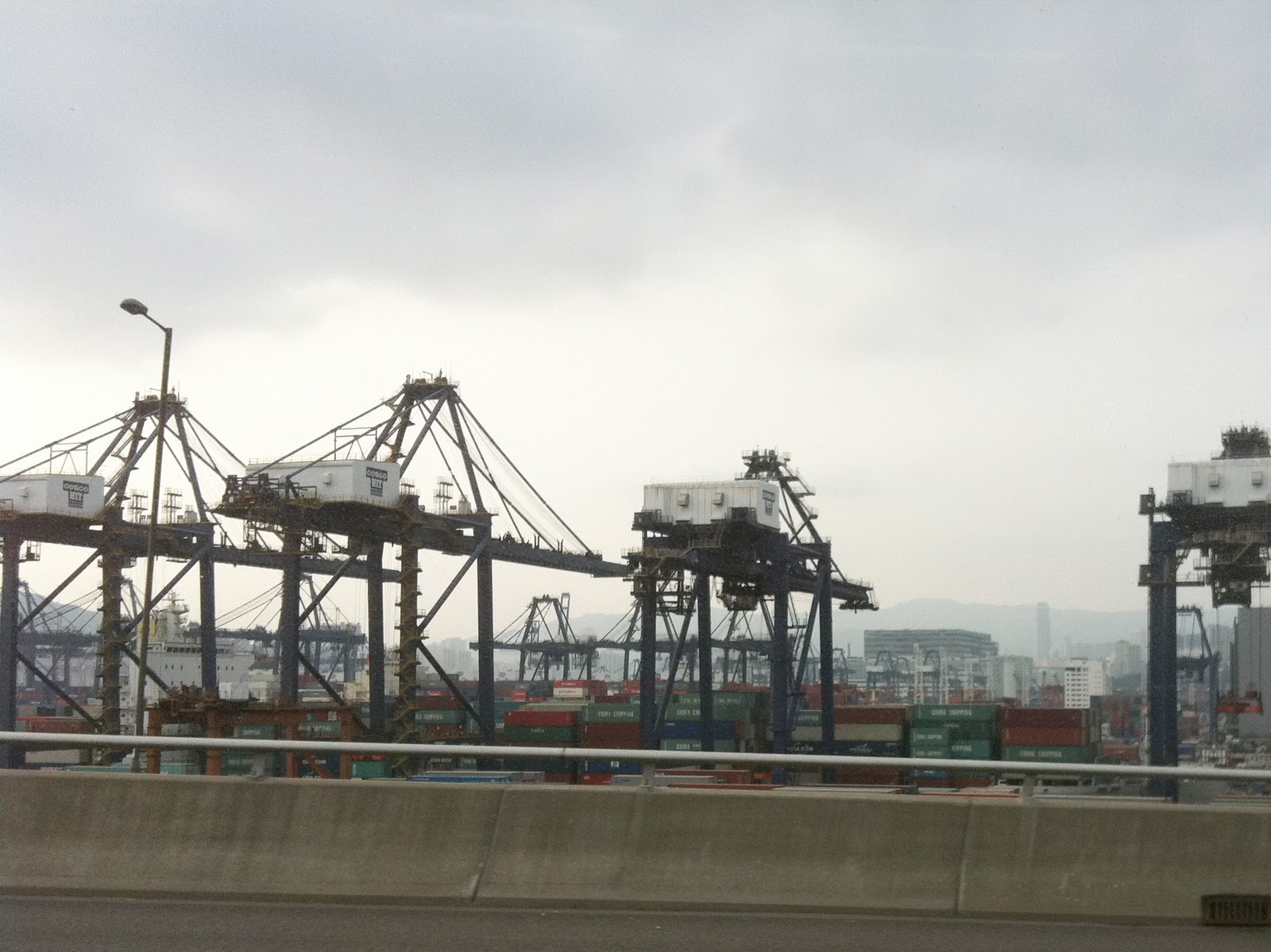
Kowloon ports

Lippo Towers on the left, nick-named the 'Koalo tree'.
The bleakness of arrival is not broken by the blazing cerise bougainvillea along the roadside. It looks dry. We drive across huge bridges linking Lantau Island to Kowloon and Hong Kong Island. At last a close-up of the ports that most of the pictures of Hong Kong ignore, which is surprising, as the city still largely functions as a hub for imports and transhipment.

For breakfast, our lactose-free milk is from Australia, the muesli from Germany and the yoghurt from Greece, all sourced from an expensive supermarket stacked with items from Waitrose (UK). On the news this morning is a report of local food costs rising as more and more of the food in Hong Kong is sourced from mainland China. The Chinese Renminbi is no longer linked to the US$ which the HK$ is and hence the dear prices. A local shopkeeper mentions that 20% of items sold in his shop, is bought by mainland Chinese paid for in Renminbi and that he has accepted the currency for the past 6 years.

The view outside across Victoria harbour is shielded by tall skyscapers and only a snip of the building site on which the new government buildings will be and opposite Kowloon can be seen. Life on the 27th floor and the continuous hum of air conditioners takes some getting used to.

Thursday, 2 September 2010

Fieldfictions

Leaving today for Devon to join the Pebblebeds Project. Have my archaeological trowel packed but do not know yet on which site I will be working. Looking forward to pebbling, this promises to change my obsession with flints that was stirred by my recent interpretation project at Grime's Graves. Hope the rain stays away.